
Hip Hinges, Bloody Shins and The Drinking Bird Cue
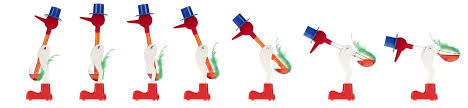
When learning to do deadlifts, good mornings, kettlebell swings and many other hip dominant movements what becomes important to learn first are the best positions to train with. Ideally, the vertical shin is the critical component to learn. It doesn't matter if you are swinging, doing good morning variations, deadlift variations or other hinge movements. The vertical shin or "L" position is the first component that is critical to the development of these patterns. If we can not learn how to allow the hips and torso to posteriorly shift backwards with an "L" position in the lower leg or vertical shin then it becomse important to do the necessary corrections for the body in order so that the position can be achieved and accessed under stress.
This position is critical to the development of the hamstrings. If you have difficulty achieving this position then the reality is that you will need assistance in order to pursue these patterns in a way that will not pile up in significant musculoskeletal dysfunction. Now some of this may be due to pelvis, abdominal or lower leg muscular imbalances. If your calves and quads are the dominant movers of your gait and the glutes as well as hamstrings are under developed what you will experience is challenges in achieving and holding the "L" position. Without the ability to do this the lower back, quads and calves will receive a disproportionate amount of training stress. With increased loading intensity, repetition and higher volumes of work the adaptations will not be favorable and problems will manifest along a relatively short developmental timeline.
In order to learn how to perform these exercises well what can be of assistance is the use of a proprioceptive aid on the back of the lower legs like a low box or low bench(10-16 inches). The execution of the exercise is made easier by reaching the arms back and behind the body as the hips travel posteriorly relative to the position of the lower leg. As the hips move backwards and forwards it may be useful to move the hands forwards and backwards to keep the alignment of the torso synchronized and in rhythm with the hips. When executed well the hip extensors of your posterior chain (the hamstrings and glutes) will facilitate hip extension while allowing the rest of the body to stabilize the movement of the torso.
Why this emphasis is important is for a couple reasons. One is for the fact that this is the simplest way to keep the movement as simple as possible. The more other motions show up in the pattern the more difficulty that individuals will have with timing the folding and unfolding of the levers. Secondly it keeps the path of the implement moving in a pretty strict path. This avoids the chaotic drama that can often unfold as people learn how to hinge. Third this keeps the bar away from the shins just enough to minimize shin trauma. It's very common in lifters who are deadlifting with bars to make a lot of contact on their shins with the bar. This is all well and good except that when you are lifting a lot of weight more contact with the bar means increased friction which means you move the bar slower to lock out and not faster. It also means.......bleeding on the bar and receiving bloody shins.....which is just not necessary.
In many cases there are many different cues that can and will also assist this learning process. However, my personal favorite that seems to work on a highly frequent basis is to move like the drinking bird. It's strangely humorous how easily this seems to correct many different hinge patterns that are becoming too complicated. The Drinking Bird is a toy that is basically a glass pendulum filled with water that is supported by two standing legs that are rigidly fixed. It seems silly and it may be ridiculous but certainly not more ridicuous than the flashlight cue. When in doubt think of yourself as the drinking bird and move accordingly. It will help assist you in achieving the correct mechanics.


Comments